
China’s wooden door industry serves a vast and changing building market. Wooden Doors are used in homes, hotels, offices, and renovation projects, where buyers weigh durability, finish, lead time, and price. The choice is rarely just about appearance.
Official figures offer useful context. China’s National Bureau of Statistics reported that new housing starts fell 20.4% in 2023, compared with the previous year. This shift makes manufacturers’ production flexibility and domestic distribution worth examining, alongside product design and export experience. The figure describes housing construction, not wooden door sales. That distinction matters.
Market research provides another lens. Mordor Intelligence’s coverage of China’s doors market tracks demand and competitive developments across product categories. Yet broad market estimates do not establish a definitive ranking of individual wooden door makers. Company claims also vary in scope. Still, comparisons can be grounded in practical evidence: factory capacity, material sourcing, quality-control processes, certifications, customization options, and delivery performance. A polished showroom is not enough.
This overview identifies leading Chinese manufacturers and explains what separates them. It considers established brands and export-oriented producers, while noting that “top” depends on the buyer’s needs. Some firms excel at large orders; others may suit bespoke projects better. That can be hard to judge from a catalogue. Readers should verify current specifications and assess samples before choosing a supplier.
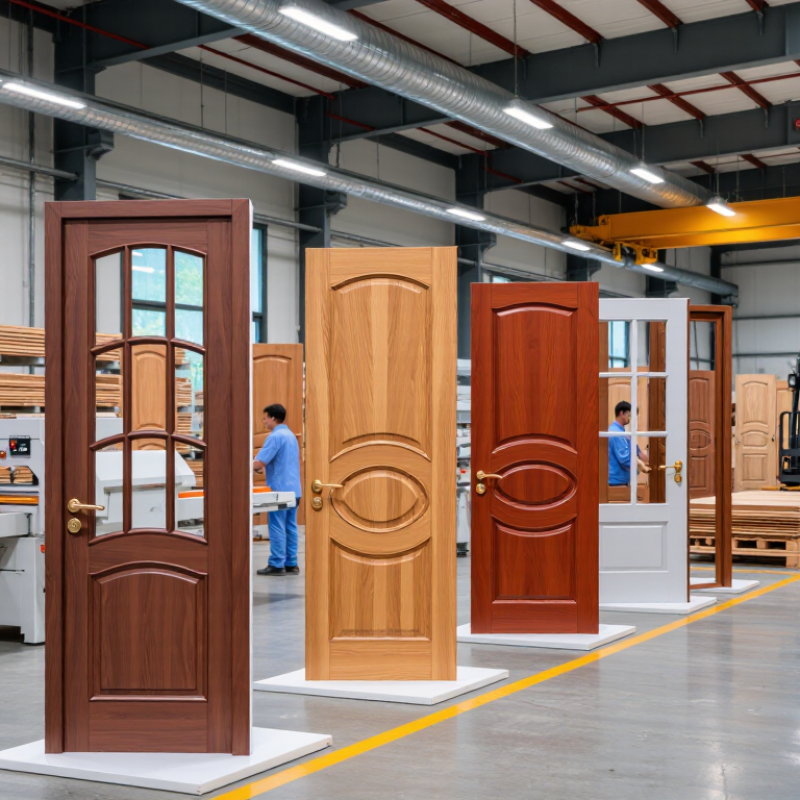
A leading wooden door manufacturer in China is defined by more than attractive finishes or a large catalogue. Look for documented control of timber sourcing, kiln drying, bonding, and coating. Ask for batch-level moisture records and independent test reports for dimensional stability, adhesion, and formaldehyde emissions. A door that looks smooth in a showroom may still warp after a humid summer. Production consistency matters.
Credible environmental information also matters. FAO’s Global Forest Resources Assessment 2020 estimated annual deforestation at 10 million hectares in 2015–2020, making traceable wood sourcing an important question for buyers. The 2019 Global Status Report for Buildings and Construction attributed 39% of global energy-related carbon emissions to buildings and construction. These figures do not measure door factories specifically, but they underline why material choices and manufacturing waste deserve scrutiny. No factory is flawless; transparent corrective-action records are more convincing than broad sustainability claims.
Tips: Request recent test reports, warranty terms, and written specifications for the exact door construction. Compare core material, veneer thickness, edge sealing, and installation requirements. If a supplier cannot explain how it controls moisture, pause before ordering.
China’s wooden door industry is organized as a network, not a single production model. Large manufacturers may manage design, machining, finishing, and packing under one roof. Smaller factories often focus on a narrower stage, such as carving panels or applying veneer. Component suppliers provide frames, cores, hardware, and surface materials. The structure varies by region and order size.
Many factories work through trading companies, distributors, or project contractors. Some make doors to a buyer’s drawings, while others adapt standard designs. A sample can look excellent under showroom lighting. The real test is whether later batches match its color, dimensions, and finish.
Small differences matter.
Production commonly combines solid wood with engineered cores or veneers, depending on cost, stability, and the intended use. Buyers should ask how moisture is controlled and how doors are checked for warping, gaps, and coating defects. Requesting a production sample and written specifications can make comparisons clearer.
Still, a factory visit or document review cannot reveal everything. That picture is incomplete. Ask how changes are recorded, who checks the final batch, and what tolerances the contract actually states.
Comparing Chinese wooden door manufacturers takes more than comparing catalog photos and quoted prices. Ask for the door’s core construction, veneer or paint specification, and documented moisture-control process. A sample cutaway can reveal hollow sections, uneven joints, or thin facing layers. Details matter. Request recent third-party test reports for emissions, sound insulation, and fire performance where relevant, and confirm that tested models match the products being quoted.
Traceable materials deserve equal attention. The FAO’s Global Forest Resources Assessment 2020 estimates that forests cover 31% of global land area and reports annual deforestation of 10 million hectares in 2015–2020. This does not certify any supplier, but it makes sourcing records worth checking. Ask manufacturers for material origin documents, chain-of-custody evidence where available, and clear explanations of what each certificate covers.
Production consistency can be checked through factory audits, batch records, and inspection samples from more than one production run. The 2023 Global Status Report for Buildings and Construction, published by UNEP, attributes 37% of global energy- and process-related CO2 emissions in 2022 to the sector. That figure is not a door-product rating; still, it supports asking about material efficiency and durability. I would also compare packaging, lead-time performance, warranty exclusions, and spare-part support. A polished showroom can hide uneven core density. Buyers sometimes overlook that.
China’s wooden-door manufacturers differ more by production model than by showroom appearance. Large integrated factories typically control panel preparation, machining, finishing, and assembly. This can improve consistency across high-volume projects. Regional specialists often offer more flexible dimensions and surface treatments, which helps with renovations or locally preferred styles. Their delivery capacity may vary, however.
The National Bureau of Statistics reported that China’s furniture manufacturers above designated size generated 655.7 billion yuan in operating revenue in 2023. This broader category includes wooden doors, so it is useful market context, not a door-market estimate. Buyers comparing manufacturers should request actual project references, written moisture-control specifications, and test results for coatings and emissions. Details matter. A polished sample is not enough.
A useful profile should also explain how a manufacturer handles timber sourcing, kiln drying, and quality checks between production batches. Ask to inspect a door’s edge, hinge recess, and finish under ordinary light; defects often show there first. Some factories publish strong technical information, while others provide little beyond catalogue claims. That gap deserves scrutiny. The available public data do not support a reliable, independent ranking of individual manufacturers, so capacity and quality claims should be verified directly.
Choosing a wooden door manufacturer starts with the project, not a catalogue. For a hotel, check whether the factory can keep dimensions and finishes consistent across hundreds of units. For a renovation, ask about non-standard sizes, lead times, and replacement panels. Request a sample with the actual veneer, edge treatment, and finish; a small color chip can hide differences. Small details matter.
Performance requirements should match the building’s use. Ask for documented test results for fire resistance, sound reduction, moisture stability, and surface durability where these are specified. Confirm that reports apply to the proposed door construction, not just a similar product. For humid bathrooms or coastal sites, discuss core materials, edge sealing, and acclimatization before production. A sample can still mislead.
Environmental documentation also deserves attention. UNEP’s 2023 Global Status Report for Buildings and Construction states that the sector produced 37% of global energy- and process-related carbon emissions in 2022. That figure is not specific to doors, but it makes material transparency relevant. Ask for wood-source documentation, product composition, and any available emissions data. Compare these records alongside price, warranty, quality-control steps, and export packaging. A lower quote may omit the details that matter most after installation. I would still ask one more question: who handles defects once the doors reach the site?