China Top Hand Crank Coffee Grinder for Camping?
A good Hand Crank Coffee Grinder For Camping should make fresh coffee without relying on power, but “portable” alone does not guarantee a useful trail companion. The National Coffee Association’s 2024 National Coffee Data Trends report found that 67% of U.S. adults had coffee the previous day, a record in its survey history. That figure is not about camping, but it shows how firmly coffee fits daily routines. Outdoors, the details change: a grinder must fit beside a stove, work steadily on a picnic table, and keep grounds out of a packed sleeping bag.
This guide looks at Chinese-made hand grinders through practical criteria, not country-of-origin claims. We consider burr material, grind adjustment, capacity, handle comfort, weight, and how easily the parts can be cleaned. A clear product specification is useful; a hands-on test is better. Where testing is unavailable, that limitation should be stated rather than hidden. Small details matter. A loose handle can rattle in a pack, while a narrow adjustment range may frustrate someone switching between pour-over and a small camping brewer. No grinder is perfect. Even a compact model can feel slow when the morning is cold and your fingers are stiff. The aim is to identify dependable options, explain trade-offs, and help readers choose a grinder suited to their brewing style and trip length. Actual performance can vary with beans, grind setting, and maintenance, so treat headline claims as a starting point, not proof.
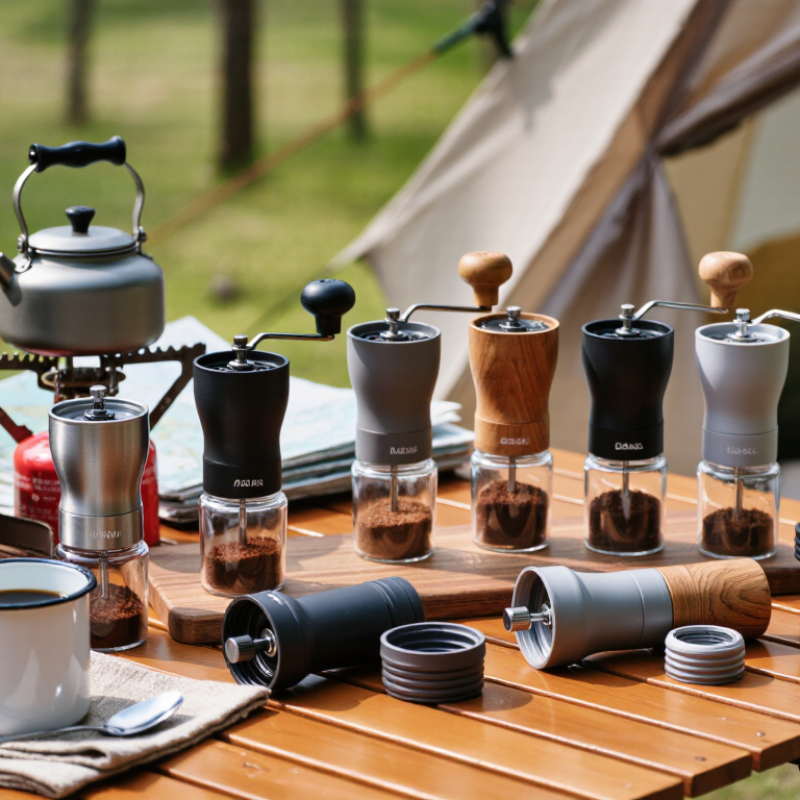
What Makes a Hand Crank Coffee Grinder Suitable for Camping
China Top Hand Crank Coffee Grinder for Camping?
What Makes a Hand Crank Coffee Grinder Suitable for Camping
A camping grinder should travel easily without sacrificing a consistent grind. Look for a compact body, a secure lid, and a crank that folds or detaches for packing. A sturdy metal burr set can handle regular use, while a simple adjustment mechanism helps match grounds to a pour-over or small press. No batteries needed. But a tiny hopper may mean several batches for a group, and loose grounds can escape if the catch cup does not fit tightly.
Tips: Grind at home if mornings are rushed. At camp, set the grinder on a flat surface, hold its body firmly, and turn the crank steadily. Keep it in a dry pouch; damp grounds are harder to brush away.
Comfort matters too. A narrow handle can become tiring when grinding beans for multiple cups, especially in cold weather. Check whether the parts are easy to clean without special tools. A lighter grinder saves pack weight, but very light construction may feel less stable on uneven ground. Test the crank and adjustment before leaving home. Small flaws are easier to notice on a kitchen counter than beside a tent.
How Manual Coffee Grinders Work
A hand crank coffee grinder uses your turning motion to rotate a central shaft. Coffee beans drop from the hopper between two burrs. These ridged surfaces crush and shear the beans into particles; they do not chop them like spinning blades. An adjustment dial changes the gap between the burrs. A narrower gap usually makes finer grounds, while a wider gap produces coarser ones. The exact adjustment system varies by grinder.
That simple mechanism suits a campsite, where power outlets may be far away. Hold the grinder steady on a flat rock or picnic table, then turn the crank at an even pace. You can feel resistance increase as the beans break down. Finer settings often take more effort. Uniform grounds can help water extract coffee more evenly, though no hand grinder makes every particle identical. I used to assume extra force meant faster grinding; it mostly made my wrist tired.
Tips: Adjust the grind before brewing, and change it in small steps. Brush out leftover grounds after use, especially around the burrs. Keep the grinder dry in your pack. A little grit can affect the crank, and cleaning outdoors is easy to forget.
Key Features of Chinese Camping Grinder Models
Chinese camping grinder models are best judged by the details that affect daily use. A compact body saves space, but it should still feel steady on a picnic table. Check the burr material, adjustment range, and whether the handle folds or detaches. A wide adjustment range helps with different brewing methods, though tiny settings can be awkward outdoors. That matters on a windy morning.
Capacity is worth checking before buying. A small hopper may suit one cup, but several servings mean repeated grinding. Metal bodies can handle packing bumps, while plastic parts may keep weight down. Neither choice is automatically better. Look for a secure lid, a grippy surface, and parts that are easy to brush clean. Faint adjustment markings are a small annoyance, and sellers do not always show them clearly. I would verify those details rather than assume every model is trail-ready.
Tips: Pack a small brush and store the grinder in a padded pouch. Test the adjustment at home. Hand grinding is quiet, but it still takes time.
How to Choose a Grinder for Outdoor Brewing
Choosing a hand-crank grinder for outdoor brewing starts with your brew method, not a long feature list. For pour-over, look for repeatable fine adjustments; for a French press, a steady coarse setting matters more. The Specialty Coffee Association’s Brewing Control Chart places desirable extraction yield at 18–22%, a useful reference when adjusting grind size. It is not a guarantee: uneven grounds, stale beans, or rushed pouring can still flatten a cup. Keep it simple. Burr alignment and a secure handle matter more than settings you can barely distinguish with cold fingers.
Weight and cleaning matter outdoors. Check packed weight, handle fit, catch-cup seal, and whether you can brush the burrs clean easily. The SCA Golden Cup Standard uses about 55 grams of coffee per litre of water, with a ±10% range. That makes a 300-millilitre brew roughly 16.5 grams at the central ratio. Useful to plan before packing. One trade-off is easy to overlook: fine grinding by hand can feel tiring, especially when it is cold. Test your grinder at home with your usual beans, then note the setting. Grounds spill. Pack a small brush.
Typical Coffee Doses for Outdoor Brewing
These are common example doses for a single brew, not fixed rules. When choosing a hand-crank grinder for camping, check that its capacity can handle your usual dose and that its grind adjustment suits your brewing method. Actual recipes vary with taste, serving size, and equipment.
Using and Maintaining a Grinder at Camp
At camp, set the grinder on a firm, level surface before adding beans. A flat rock or picnic table works better than a knee, especially when the handle turns stiffly. Measure only what you plan to brew; loose beans can bounce into dirt or grass. Keep the grinder away from blowing dust, and close its lid between uses. Small details matter.
Turn the handle steadily rather than forcing it. If the grind feels uneven, check the adjustment and make a small change before grinding another dose. Camp conditions can make this fiddly. I sometimes over-tighten the adjustment, then have to back it off and start again. After brewing, tap out the grounds and brush the burr area with a dry, soft brush. Avoid rinsing the grinder unless its care instructions allow it; trapped moisture can encourage rust or leave old coffee residue. Wipe the outside with a damp cloth, then dry it fully before packing. A cloth pouch helps keep grit away, though it will not protect the grinder if it gets crushed beneath cookware. Check the crank and adjustment nut before leaving camp. Loose parts are easy to miss in dim light.