
×

7 Tips for Buying Powder Coated MDF Furniture?

Powder Coated MDF furniture can deliver a smooth, durable finish, but the coating is only part of the story. The board beneath it, the edge treatment, and the curing process all affect how a piece performs in daily use. A tabletop may look flawless under showroom lights, yet swollen edges or a poorly bonded finish can appear after repeated cleaning or contact with moisture. Small details matter.

The U.S. Environmental Protection Agency’s TSCA Title VI sets a formaldehyde emission limit of 0.11 parts per million for MDF. Buyers can ask whether a product is certified as compliant and request clear documentation. The USDA Forest Products Laboratory’s Wood Handbook also explains how wood-based materials respond to moisture, a useful reminder that MDF is not waterproof. These sources do not rate individual furniture brands, so product-specific evidence still matters. A claim alone is not proof.

This guide outlines seven practical checks: board quality, panel thickness, edge sealing, coating consistency, finish durability, hardware, and warranty terms. Ask how the powder coating is cured, and inspect corners in person when possible. Look for chips, rough edges, and uneven gloss. Very simple, but revealing. I would also be cautious about impressive scratch-resistance claims without a named test method or results. A strong purchase combines credible specifications with careful inspection—and honest expectations about where the furniture will be used.
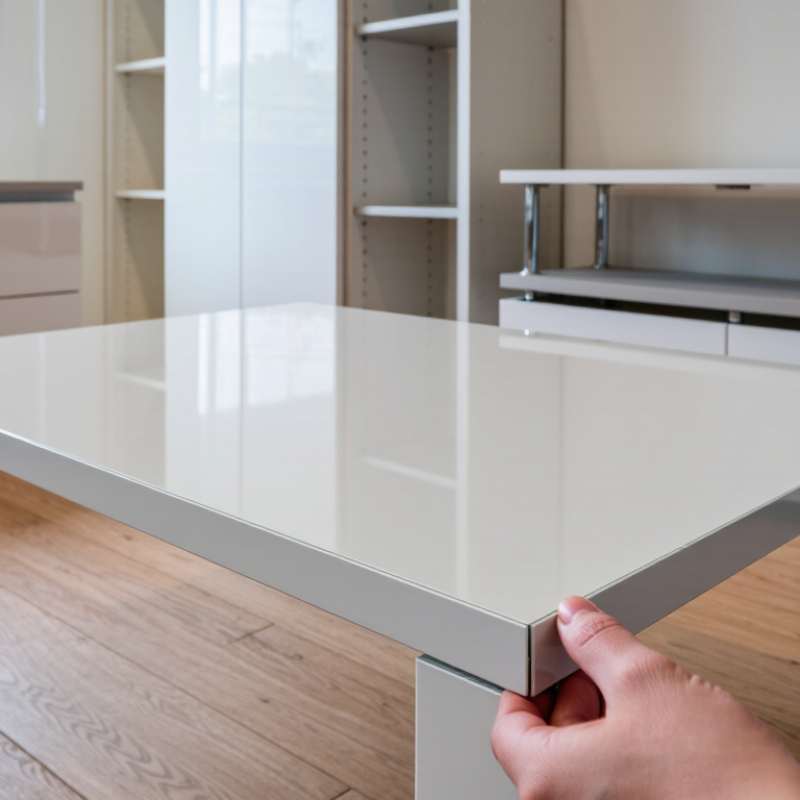
7 Tips for Buying Powder Coated MDF Furniture?

Check MDF Density (Typically 600–800 kg/m³) and E1 Formaldehyde Limits (≤0.124 mg/m³)

MDF density is a useful first check when comparing powder-coated furniture. Many panels fall around 600–800 kg/m³, but the figure can vary by thickness and construction. Ask whether the stated value describes the whole board or a particular layer. Density alone does not guarantee a sturdy shelf. Check the panel thickness, edge finish, and how the joints are fixed. If possible, inspect a sample: a clean, even edge is reassuring, while crumbly material deserves a closer look. Small details matter.

Formaldehyde emissions need the same careful attention. For an E1 claim, look for a test report showing emissions at or below 0.124 mg/m³, and confirm the test method and report date. A label alone may not show how or when the panel was tested. Ask the seller for documentation tied to the product or board specification. Keep in mind that test results depend on the method and conditions, so numbers from different reports may not be directly comparable. I would not treat density or an E1 label as a complete quality verdict. They are useful checks, not guarantees.

7 Tips for Buying Powder Coated MDF Furniture? — Check MDF Density (Typically 600–800 kg/m³) and E1 Formaldehyde Limits (≤0.124 mg/m³)

Tip What to Check Useful Benchmark or Evidence Why It Matters
1 Check the MDF panel density stated in the technical specification. Typically 600–800 kg/m³; confirm the figure for the actual panel and thickness. Density can affect panel weight, stiffness, screw holding, and machining. It is not, by itself, a guarantee of furniture strength.
2 Ask for formaldehyde-emission documentation for the MDF used. E1: ≤0.124 mg/m³, commonly referenced to chamber testing under EN 717-1. A test report helps verify emissions. Check that the report identifies the relevant panel or product and its test method.
3 Verify that the powder-coating process is designed for MDF. Request the coating system and process details for MDF, including the pretreatment and curing method. MDF is not metal. A coating process intended only for metal may not adhere properly or may expose the panel to unsuitable heat.
4 Inspect the coating for even coverage and intact edges. Look for consistent color and finish, with no visible bare areas, blisters, cracks, or peeling. Damaged or incomplete coverage can reduce protection and affect appearance. Examine corners, cut-outs, and other vulnerable areas.
5 Check panel thickness and how the furniture is supported. 18 mm is a common furniture-panel thickness, but requirements vary with design, span, and construction. Thickness alone does not determine load capacity. Ask for the manufacturer’s stated load rating and assembly instructions.
6 Consider moisture exposure and edge protection. For humid conditions, look for MDF specified for humid-service use, such as an EN 622-5 MDF.H grade, where applicable. Moisture-resistant MDF is not waterproof. Protect exposed edges and follow the care instructions, especially near sinks or damp floors.
7 Review hardware, assembly details, and warranty coverage. Check hinge and drawer operation, included fasteners, wall-fixing guidance, and written warranty terms. Reliable hardware and clear installation guidance contribute to safe, durable use. Confirm what the warranty covers and excludes.

Benchmarks are general buying guidance. Confirm the applicable standards, test reports, product specifications, and local requirements for the furniture you plan to purchase.

Confirm the Powder-Coating Process Suits MDF’s Heat and Moisture Sensitivity

Powder-coated MDF can offer a smooth, durable finish, but the process must suit the board. MDF contains wood fibers and resin, so heat and moisture can cause swelling, warping, or surface damage. Standard metal-coating temperatures may be unsuitable. Ask whether the furniture uses MDF designed for powder coating and a low-temperature curing process. Exact limits vary by board and coating, so request the supplier’s specifications rather than relying on a general claim.

Buying tips: Ask for the curing temperature and time. Check the edges, corners, and underside for even coverage. Look for guidance on humidity and cleaning. Request a finished sample if possible. A small test piece can reveal rough edges or color differences that photos may hide.

Inspect joints and exposed edges closely; they can absorb moisture faster than sealed faces. In a showroom, run a hand along the corners and look for bubbles, cracks, or thin spots. I would still want written care instructions, since “moisture resistant” does not mean waterproof. One detail is easy to miss: a flawless top surface cannot confirm how well the board was prepared or cured.

Assess Coating Adhesion With ISO 2409 (Class 0 Is the Best Rating)

When inspecting powder coated MDF furniture, ask how coating adhesion was checked, not just whether it was tested. ISO 2409 uses a small cross-cut grid through the coating, followed by a controlled tape pull. The result is rated from Class 0 to Class 5. Class 0 is best: the cut edges remain clean, with no coating squares detached. A neat grid matters.

Check that the report identifies the actual MDF coating system and test conditions. A test on a metal panel, for example, may tell you little about the furniture in front of you. MDF can have a different surface texture, primer, and curing response. Ask to see a close-up of the tested area and confirm the sample represents the production finish. Look for lifted corners or flakes around the cuts.

Class 0 is reassuring, but it is not a promise against every scratch, impact, or damp room. ISO 2409 measures resistance to separation after cutting; it does not reproduce years of chair legs knocking a cabinet. Still, the rating is useful. If the seller cannot provide a test record, inspect hidden edges and corners carefully. I would treat a vague “strong adhesion” claim with caution.

Compare Moisture Resistance Using EN 317’s 24-Hour Thickness-Swelling Test

Powder-coated MDF can look sealed, but the coating does not make every edge waterproof. EN 317:1993 measures thickness swelling after a 24-hour water immersion. Measure the dry panel first, then compare its thickness after testing: swelling (%) = thickness increase ÷ original thickness × 100. For example, an 18.0 mm panel measuring 19.4 mm afterward swells about 7.8%. That figure is illustrative, not a product rating.

Tip: Ask for the actual EN 317 test result, panel thickness, and test conditions. EN 622-5 sets performance requirements for MDF panels, but results must be read against the relevant panel type and intended use. A low swelling result can be useful, yet it does not prove a finished cabinet will resist spills at joints, screw holes, or cut edges. Check those details in person. Look for exposed brown core near hinges; even a neat coating can hide vulnerable edges.

Compare like with like. A thicker sample or a different panel grade may produce a misleading comparison. Industry standards give a repeatable test method, not a guarantee of service life in a steamy kitchen. I would also ask whether the furniture maker tests finished components, since water can enter where panels meet. One detail is easy to miss: swelling is not the same as water absorption. EN 317 focuses on thickness change, so inspect the coating and edge sealing separately.

7 Tips for Buying Powder-Coated MDF Furniture

Compare moisture resistance with EN 317’s 24-hour thickness-swelling test

How to read this chart: These are calculated examples—not measured product results or EN 317 pass/fail limits. For an 18 mm board, thickness swelling is calculated as ((thickness after immersion − initial thickness) ÷ initial thickness) × 100. EN 317 assesses board thickness swelling after 24 hours of water immersion; it does not directly test the powder-coated surface or the complete furniture item. Ask for test results for the specific board and finished product, and check how edges and joints are protected.

Check Finish Durability With ASTM D3359 (5B Is the Best Adhesion Rating)

A glossy surface can hide weak bonding. Before buying powder-coated MDF furniture, ask how the finish was tested and request the written result. ASTM D3359 rates tape-test adhesion from 0B to 5B. A 5B rating is the best: no coating is removed from the test area. A 4B result allows small flakes at cut intersections, affecting less than 5% of the area. Those numbers give you a practical comparison, not a promise that every panel will behave identically.

There is an important caveat. ASTM D3359 was developed for coatings on metallic substrates, so an MDF result should be described as an adapted screening test, not automatic proof of formal compliance. Ask whether the sample used the same MDF, primer, edge treatment, and curing process as the furniture. Check that cuts reach the coating layer, and look closely at corners, screw holes, and edges, where lifting often starts. A neat top surface is not enough. If possible, request results from several panels rather than one hand-picked sample; variation between panels can be easy to miss. A 5B score is encouraging, but it does not test scratch, impact, or moisture resistance.