
×

What Is a PDU Switchboard and How Does It Work?

A Pdu Switchboard is more than a metal cabinet filled with breakers. It is a controlled power-distribution point that connects incoming electrical service with sensitive computing or industrial loads. In a typical data center, power may travel from utility service or generators through switchgear, transformers, and UPS systems before reaching the PDU Switchboard. Inside, busbars, circuit breakers, meters, and protection devices divide that power into safer, measurable circuits.

The numbers explain why this equipment deserves careful attention. The International Energy Agency’s Electricity 2024 report estimates that data centers consumed about 460 TWh globally in 2022. Their demand could exceed 1,000 TWh by 2026. Uptime Institute’s 2024 Global Data Center Survey also reported that 54% of respondents experienced an outage costing more than $100,000. Small distribution weaknesses can become expensive failures.

Patrick Donovan, a senior research analyst at Schneider Electric, describes the practical role simply: “A PDU distributes power to IT equipment.” That sentence is brief. The engineering is not. A well-designed PDU Switchboard balances phases, isolates faults, supports maintenance, and shows real-time load conditions. Technicians may inspect a warm breaker, a crowded cable entry, or a rising current reading before a failure develops. Yet a clean diagram can hide poor coordination. Ratings, short-circuit capacity, grounding, and monitoring settings must match the installation. This article explains how a PDU Switchboard works, where it fits in the power chain, and which design details deserve a second look.
What Is a PDU Switchboard and How Does It Work?

What Is a PDU Switchboard?

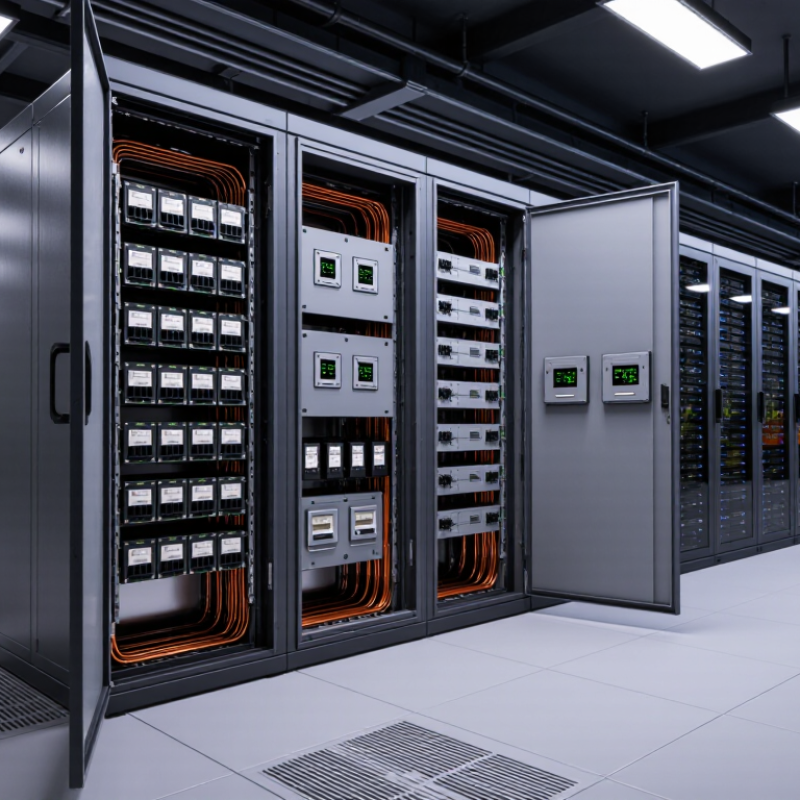
A PDU switchboard is an electrical distribution assembly that receives power and sends it safely to multiple downstream circuits. PDU means Power Distribution Unit. In a switchboard, the unit may include a main disconnect, circuit breakers, busbars, meters, and outgoing terminals. These parts are arranged inside a protected enclosure. The enclosure may stand near servers, industrial equipment, or other high-demand loads.

Its job is practical. Incoming power enters through the main connection. Protection devices interrupt faults or overloads. Busbars carry power across the cabinet, while branch breakers divide it into separate circuits. Meters can show voltage, current, energy use, or phase balance. Technicians may then identify an overloaded circuit before heat damages insulation. Clear labels and accessible cable routes also make inspection safer and faster.

The exact design depends on voltage, current, phase arrangement, grounding, and installation conditions. A PDU switchboard is not simply a larger power strip. It requires coordinated protection and careful load calculations. Naming can vary between industries, which sometimes creates confusion. A unit described as a switchboard may contain PDU functions, but not every PDU has full switchboard capability. That distinction deserves checking. In practice, engineers should verify breaker ratings, short-circuit capacity, enclosure protection, ventilation, and maintenance access. One overlooked detail can weaken an otherwise sound design. Human error remains possible, especially when labels are unclear or circuits change after installation.

Key Components and Internal Structure of a PDU Switchboard

What Is a PDU Switchboard and How Does It Work?

A PDU switchboard distributes electrical power from an upstream source to servers and critical equipment. Its internal structure usually starts with an incoming isolator or main circuit breaker. This device accepts utility, generator, or UPS power and provides the primary protection point. Copper or aluminum busbars then carry current across the cabinet. They must be correctly sized for load, temperature, and fault levels.

The outgoing section contains molded-case or air circuit breakers for individual feeders. These breakers isolate faults before they spread. Metering modules measure voltage, current, frequency, power factor, and energy use. Advanced monitoring also records temperature and breaker status. Some designs include automatic transfer equipment, bypass paths, or dual power inputs for greater resilience. Keep clear separation inside the cabinet. It matters.

The Uptime Institute’s 2023 Global Data Center Survey reported that 55% of respondents experienced an outage during the previous three years. Power problems remain a major contributor. This makes selective coordination, labeling, and thermal inspection more than paperwork. They are operational controls. Field commissioning teams often discover loose terminations or poorly balanced phases, even in new installations. That assumption is risky.

A PDU switchboard should also support maintenance without unnecessary interruption. Lockable compartments, finger-safe barriers, and accessible test points improve safety and serviceability. The 2023 survey also found that 60% of reported outages cost less than 100,000 US dollars, but smaller events can still damage trust. Design calculations may look perfect. Real installations still need disciplined inspection, testing, and honest review.

How a PDU Switchboard Distributes and Controls Power

What Is a PDU Switchboard and How Does It Work?

A PDU switchboard is the facility’s controlled power crossroads. It receives upstream electricity, divides it into feeder circuits, and supplies racks, cooling equipment, and auxiliary loads. In practical terms, it combines switchgear, protection, metering, and distribution paths in one coordinated assembly. It is not merely a larger power strip. The distinction matters.

Power flows through breakers, busbars, and outgoing feeders. Protective devices interrupt faults before damaged circuits affect wider operations. Metering records voltage, current, power factor, and energy use. Operators can then identify an overloaded phase or an unusual rise in consumption. Some designs support dual power paths, bypass arrangements, or automatic transfer equipment. These features help maintain continuity during maintenance or feeder failure, but they do not remove every risk.

Demand is becoming harder to manage. The International Energy Agency’s Electricity 2024 report estimates that data centres, artificial intelligence, and cryptocurrency could consume 620–1,050 TWh annually by 2026. The Uptime Institute’s 2024 outage analysis found that 54% of reported significant outages cost more than $100,000. That makes accurate distribution control financially important. During commissioning, technicians check phase balance, breaker coordination, alarm thresholds, and thermal rise. A warm cable lug may reveal a loose connection before failure. Small details matter. Yet even good meters can mislead when sensors drift or loads change quickly. PDU switchboards require periodic testing, clear labeling, and human review—not blind trust in automation.

Common Types and Applications of PDU Switchboards

A PDU switchboard distributes electrical power from an incoming source to several equipment circuits. It combines switching, protection, monitoring, and cable management in one enclosure. In a data room, it may feed rack-mounted servers, cooling units, and network devices. Clear labels and accessible breakers help technicians isolate faults quickly.

Common types include single-phase and three-phase PDU switchboards. Single-phase models suit small server rooms, laboratories, and compact communication cabinets. Three-phase designs support higher loads and distribute current more evenly across circuits. Basic models provide outlets and overload protection. Metered versions display voltage, current, and power consumption. Monitored models transmit readings to a central system. Switched models also allow remote outlet control, although remote control should never replace local safety procedures.

Applications vary with operating conditions. Data centers often use monitored switchboards to compare rack loads and detect unusual temperature changes. Industrial control rooms may require rugged enclosures, while edge sites benefit from compact units with limited maintenance needs. Modular switchboards can simplify future expansion. They are not always the cheapest choice. Engineers should calculate continuous load, startup current, short-circuit ratings, and available power capacity before installation. Balanced phases reduce wasted capacity and heat. A small oversight matters. I have found that neat cable routing often improves troubleshooting more than advanced software. Still, every design needs review by qualified electrical professionals and regular inspection records.

What Is a PDU Switchboard and How Does It Work? - Common Types and Applications of PDU Switchboards

A PDU switchboard is an electrical distribution assembly that receives power from an upstream source, protects and switches outgoing circuits, and distributes electricity to multiple loads. Depending on its design, it may also measure electrical parameters, provide alarms, and support remote monitoring.

Common Types and Applications of PDU Switchboards
Type How It Works Typical Electrical Configuration Typical Capacity Range Protection and Switching Monitoring Functions Common Applications Main Advantages Important Limitations
Basic PDU Switchboard Distributes incoming power through branch circuit protection to multiple outlets or load connections without advanced communications. Single-phase or three-phase; low-voltage AC distribution. Usually sized from small branch distribution ratings to several hundred amperes, depending on the enclosure and feeder design. Fuses or circuit breakers; main isolator; branch overcurrent protection. Local voltage, current, or status indication may be provided. Small equipment rooms, workshops, commercial buildings, and general-purpose electrical distribution. Simple Cost-effective Easy to maintain Limited visibility of energy use and limited remote control capability.
Metered PDU Switchboard Measures electrical parameters at the incoming feeder or individual branch circuits while distributing power to connected loads. Single-phase or three-phase; voltage and current measurement on selected circuits. Determined by the connected feeder and branch-circuit ratings. Circuit breakers or fuses, disconnects, and optional surge protection. Voltage, current, frequency, power, power factor, and accumulated energy may be displayed locally. Data centers, laboratories, production areas, and facilities that need energy allocation or capacity checks. Improved visibility Load balancing support Metering accuracy, sensors, and communications require correct installation and periodic verification.
Monitored PDU Switchboard Collects electrical measurements and sends operating data to a building management, energy management, or data-center infrastructure system. Single-phase or three-phase; networked monitoring at the inlet and/or branch level. Scales from a single cabinet to multiple interconnected distribution sections. Overcurrent protection, isolation, alarm thresholds, and optional environmental inputs. Remote readings, overload alarms, circuit status, energy reports, and event logs. High-availability data centers, network rooms, process facilities, and energy-managed buildings. Remote visibility Proactive alarms Trend analysis Depends on network availability, cybersecurity controls, compatible protocols, and accurate configuration.
Switched PDU Switchboard Combines power distribution with remotely controlled switching of selected outlets or branch circuits. Single-phase or three-phase; remotely controlled branch outlets or breakers. Varies with the number of controllable outlets and the rating of each branch circuit. Branch overcurrent protection, outlet switching, interlocks, and local emergency controls where required. Remote outlet status, current measurements, load alarms, and command history. Server rooms, telecommunications facilities, test laboratories, and remotely managed technical spaces. Remote power cycling Load control Reduced site visits Incorrect remote commands can interrupt equipment; control access and change management are essential.
Rack-Mounted PDU Installs inside or alongside an equipment rack and distributes power to rack-mounted servers, switches, or instruments. Commonly single-phase; three-phase models are used for higher-density installations. Designed for rack-level loads and constrained mounting spaces; exact capacity depends on voltage, connector type, and circuit rating. Input protection, branch protection where applicable, and overload indication. Basic, metered, monitored, or switched configurations are available. IT racks, telecommunications cabinets, broadcast equipment, and laboratory instrument racks. Space-efficient Direct rack distribution Easy deployment Must remain within rack thermal, mechanical, connector, and available electrical capacity limits.
Floor-Standing PDU Switchboard Receives a larger feeder and distributes power through multiple outgoing circuits from a freestanding enclosure. Usually three-phase for medium- or high-density distribution; may include multiple sections. Often used for higher feeder and branch-circuit ratings than rack-mounted units; final capacity is determined by the design and protective devices. Main incoming breaker, busbars, feeder breakers, branch breakers, isolation, and optional surge protection. May include section-level, feeder-level, or branch-level metering and alarms. Data-center power rooms, industrial plants, commercial facilities, and large equipment areas. High distribution density Expandable layout Accessible maintenance Requires floor space, suitable working clearances, ventilation, and coordinated installation procedures.
Static Transfer PDU Switchboard Uses solid-state switching to transfer a load between two independent power sources when the preferred source is unavailable or outside configured limits. Typically dual-source three-phase AC distribution for critical loads. Selected according to the critical-load feeder rating and required transfer performance. Input protection, bypass arrangements, source isolation, and transfer interlocks. Source voltage, frequency, current, transfer events, alarms, and bypass status. Critical data-center loads, healthcare support systems, control systems, and industrial process equipment. Fast source transfer Improved availability Both sources must be properly coordinated; harmonics, fault levels, bypass operation, and maintenance procedures require careful engineering.
Modular PDU Switchboard Uses replaceable or configurable distribution modules so that branch circuits, monitoring devices, or capacity sections can be added or changed. Single-phase or three-phase; modular feeder and branch arrangements. Capacity depends on the enclosure, busbar system, available spaces, and upstream protection. Modular breakers, fused switches, disconnects, and optional surge protection. Module-level metering, circuit status, alarms, and communications may be integrated. Growing data centers, laboratories, manufacturing lines, and facilities with changing loads. Flexible expansion Reduced redesign Adaptable maintenance Modules must be compatible with the assembly and installed only under approved isolation and safety procedures.
How a PDU Switchboard Works
Operating Stage Process Key Components Purpose
1. Power Inlet Electrical power enters from a utility service, generator, UPS, transformer, or another upstream distribution board. Incoming terminals, feeder cables, main isolator, and protective device. Provides a controlled and isolatable connection to the PDU switchboard.
2. Protection The incoming and branch protective devices interrupt current during overloads or short circuits within their defined operating limits. Circuit breakers, fuses, residual-current devices where required, and surge protective devices where specified. Limits equipment damage and helps protect conductors and connected loads.
3. Distribution Busbars or internal conductors divide the incoming supply into individually protected outgoing circuits. Busbars, distribution blocks, branch breakers, terminal blocks, and outlet assemblies. Delivers power to multiple loads while allowing circuits to be isolated independently.
4. Measurement Sensors and meters measure selected electrical quantities at the inlet, distribution section, or branch circuit. Current transformers, voltage sensors, power meters, and local displays. Shows loading, energy consumption, phase balance, and operating conditions.
5. Control and Communication Advanced models transmit measurements and alarms, and may execute authorized switching commands. Controller, communication interface, network connection, alarm contacts, and remotely operated switches. Supports centralized monitoring, scheduled control, and faster fault response.
6. Load Delivery Protected output circuits supply servers, machines, lighting panels, instruments, or other electrical loads. Output connectors, feeder terminals, branch cables, and equipment grounding conductors. Provides reliable power while maintaining circuit separation and serviceability.
Design note: Actual voltage, current, short-circuit withstand rating, enclosure rating, wiring method, protection settings, and monitoring features must be selected according to the local electrical code, system voltage, fault level, connected-load profile, environmental conditions, and the requirements of the installation.

Safety Features, Maintenance, and Selection Considerations

A PDU switchboard receives incoming power, protects circuits, and distributes controlled output to racks or industrial loads. Its breakers, busbars, meters, and protective relays work together. Safety begins with physical barriers, insulated covers, clear labels, and correctly rated overcurrent protection. Interlocks can prevent unsafe door opening or switching. Arc-flash risk still demands a documented procedure, suitable PPE, and qualified personnel. Never treat a dark panel as a dead panel.

Maintenance needs routine, not assumptions. Inspect terminals for looseness, heat marks, corrosion, and damaged insulation. Clean dust with approved methods, because careless air pressure can push debris into sensitive parts. Verify torque against the specified value. Test alarms, breakers, meters, and residual-current protection where installed. Infrared inspection can reveal hot connections before failure, but it cannot replace hands-on checks. Record readings, dates, defects, and corrective actions. Small omissions become expensive lessons. Even careful teams miss a loose connection.

Selection should match the electrical and physical environment. Confirm voltage, phase, continuous current, short-circuit rating, spare capacity, enclosure rating, cable entry, and available floor space. Consider metering, remote monitoring, bypass capability, and maintenance access. In a humid or dusty room, enclosure protection matters more than attractive features. Ask how the board will be isolated during service. This question is often missed. A conservative design may cost more initially. Insufficient capacity, poor ventilation, or unclear labeling can cost far more later. Review drawings with a licensed electrical professional before purchase and commissioning.