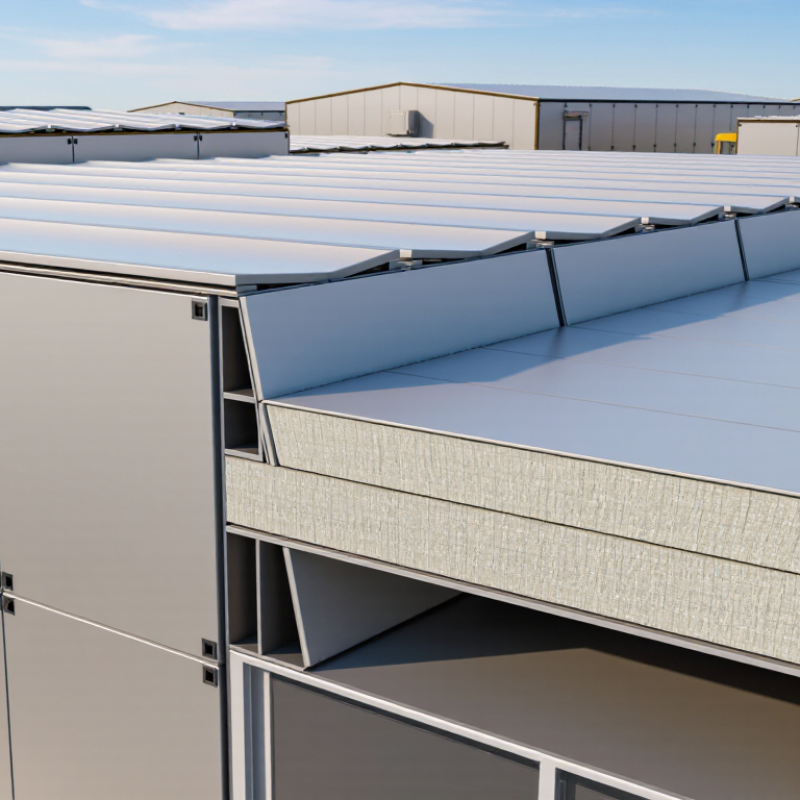
| Core Material | Identify whether the insulation core is PIR, PUR, EPS, XPS, or mineral wool. | The core type should match the required thermal, fire, moisture, and structural performance. | Request the technical data sheet, safety data, composition details, and applicable test reports. | The supplier cannot clearly identify the core chemistry or construction. |
| Long-Term Thermal Stability | Check whether the stated thermal conductivity is initial or aged and whether the value is tested at a defined temperature. | Prefer declared aged design values or long-term design data rather than initial laboratory values alone. Lower thermal conductivity generally provides better insulation. | Ask for test methods, conditioning time, test temperature, declared value, and design value. Compare reports with the product specification. | Only an exceptionally low initial conductivity is advertised, with no aging or design-value information. |
| Dimensional Stability | Review thickness change, length change, width change, and warpage after heat and humidity exposure. | Use the project specification and the applicable product standard; tight, consistent dimensional tolerances are essential for joint performance. | Request dimensional-stability test results and inspect sample panels after conditioning. Measure thickness and squareness at several points. | Visible bowing, uneven thickness, open joints, or inconsistent panel dimensions. |
| Panel Thickness | Confirm nominal thickness, tolerance, and whether the thickness includes facings, coatings, or profiles. | Common insulated panel thicknesses are approximately 40–200 mm, but the correct value depends on climate, U-value target, and structural design. | Measure multiple locations on production samples using a calibrated thickness gauge. | The measured thickness is below tolerance or varies significantly across one panel or one production batch. |
| Thermal Transmittance | Evaluate the complete panel U-value, including core, facings, joints, and thermal bridges where applicable. | Lower U-value means lower heat transfer. The required value should be calculated for the project climate and building code. | Request calculations or laboratory reports using recognized heat-transfer test procedures and the actual panel thickness. | The supplier provides only a core conductivity value and does not state panel U-value or calculation conditions. |
| Fire Performance | Check reaction-to-fire classification, fire resistance, smoke production, and burning-droplet behavior where relevant. | Fire requirements depend on occupancy, building height, use, installation direction, joints, and local regulations. | Obtain reports for the complete panel assembly, not only the foam core. Confirm the tested thickness, facing, joint, and mounting method. | A core-only fire statement is presented as proof of complete-panel fire resistance. |
| Moisture Resistance | Review water absorption, vapor permeability, edge protection, joint sealing, and exposure limitations. | The panel should be suitable for the expected indoor humidity, exterior exposure, and condensation conditions. | Request water-absorption and water-vapor test results. Inspect cut edges, tongue-and-groove joints, sealants, and protective coatings. | Exposed foam edges, damaged coatings, missing joint seals, or storage in standing water. |
| Facing and Coating | Check facing material, metal thickness, coating type, adhesion, corrosion resistance, and color consistency. | Facing selection should reflect indoor humidity, ultraviolet exposure, chemical contact, impact risk, and cleaning requirements. | Review coating specifications and inspect scratches, blistering, delamination, edge corrosion, and surface waviness. | Unspecified steel grade or coating thickness, poor adhesion, visible rust, or inconsistent surface finish. |
| Bond Strength | Verify adhesion between the foam core and facings over the entire panel area. | A sound bond should prevent delamination during handling, temperature cycling, wind loading, and service use. | Request peel, tensile, or delamination test data relevant to the product standard. Examine cut samples for voids and separation. | Large unbonded areas, hollow sounds, foam separation, or facings that detach during cutting. |
| Mechanical Performance | Review compressive strength, tensile strength, shear strength, flexural behavior, and allowable spans. | Structural capacity must be based on panel geometry, core type, facing properties, span, support conditions, and load duration. | Request design tables and test reports for the exact panel construction. Do not use core strength alone for structural design. | Unverified span tables, missing load assumptions, or structural claims based only on foam density. |
| Density and Uniformity | Check core density distribution, cell structure, voids, inclusions, and cut-face consistency. | Density should remain within the supplier’s declared tolerance and should be consistent across the panel thickness and production batch. | Use batch sampling, weight-per-volume checks, visual inspection, and independent laboratory testing when the application is critical. | Large density variation, visible voids, brittle areas, powdering, or unexpectedly light panels. |
| Joint Design and Air Tightness | Assess interlocking profiles, gasket or sealant compatibility, joint compression, and installation tolerance. | Joints should limit air leakage, water penetration, thermal bridging, and movement-related gaps. | Review assembly drawings and conduct sample-fit checks. For controlled environments, verify complete-room air-tightness requirements separately. | Loose joints, incompatible sealants, incomplete profiles, or no documented installation procedure. |
| Manufacturing Traceability | Confirm that each panel can be linked to a production date, batch, specification, and inspection record. | A reliable supplier should maintain documented quality-control records and retain representative samples or test data by batch. | Ask for batch numbers, inspection plans, calibration records, nonconformance procedures, and certificates of conformity. | No batch identification, generic certificates, altered documents, or inability to trace raw materials. |
| Supplier Capability | Evaluate production capacity, technical support, quality personnel, export experience, and process consistency. | The supplier should be able to explain production controls, tolerances, testing, packaging, storage, and corrective actions. | Conduct a documented factory audit or request an independent inspection before full-scale production. | Unclear manufacturing location, subcontracting without disclosure, inconsistent answers, or refusal of inspection. |
| Third-Party Testing | Check whether critical performance claims are supported by an independent, competent laboratory. | Reports should identify the tested product, construction, dimensions, conditioning, test date, laboratory, and result. | Verify report authenticity and confirm that the tested construction matches the purchased panel. | Expired reports, unrelated samples, missing test conditions, or documents with unexplained inconsistencies. |
| Sample Approval | Compare approved samples with mass-production panels before shipment. | The approved sample should define dimensions, facings, coating, color, joint profile, surface quality, and packaging requirements. | Use a pre-shipment inspection with agreed acceptance limits and random sampling from multiple packages. | The supplier changes materials, thickness, coating, or joint details without written approval. |
| Packaging and Storage | Check protection against moisture, ultraviolet exposure, impact, compression, and contamination during transport. | Panels should remain dry, supported, protected from standing water, and stored according to the supplier’s written instructions. | Inspect packaging on arrival and record dents, wet cartons, crushed edges, shifted stacks, and damaged protective film. | Wet packaging, unsupported overhangs, excessive stacking pressure, or prolonged outdoor exposure. |
| Warranty and Technical Support | Review warranty coverage, exclusions, service conditions, installation requirements, and claim procedures. | Warranty terms should be tied to measurable product properties and clearly define responsibilities for product defects and installation issues. | Request written warranty terms, installation guidance, maintenance instructions, and a named technical contact. | Broad claims such as “no aging” without defined service conditions, test basis, or warranty limitations. |