×

What Are Dinosaur Fossils and How Are They Sourced?

Dinosaur Fossils preserve more than ancient bones. They record movement, growth, disease, feeding habits, and vanished ecosystems. Their study begins in rock, not a museum display. Paleontologists examine sediment layers, surrounding minerals, and the fossil’s exact position. These details help establish age and scientific meaning.

Dr. Mark Norell, a leading paleontologist, has stated, “Birds are living dinosaurs.” This perspective changes how researchers interpret Dinosaur Fossils today. A fossilized claw, tooth, or vertebra can connect extinct animals with modern biology. However, identification is rarely simple. Broken bones may resemble different species. Restoration can also create misleading shapes. Researchers must remain cautious.

Responsible sourcing depends on documented excavation and legal permits. Professional teams record coordinates, photographs, rock samples, and field notes before removing a specimen. They stabilize fragile material with suitable conservation methods. Museums and universities usually preserve important fossils for public study. Provenance records are essential. Without them, even an authentic fossil may lose much of its scientific value.

Some specimens come from private collections or commercial dealers. Their history may be incomplete. That weakness deserves attention. Ethical experts verify ownership, export rules, and local heritage requirements before acquisition. They also avoid encouraging unauthorized excavation. Science is not merely about possessing spectacular bones. It is about protecting evidence for future research. The best Dinosaur Fossils tell a reliable story because their geological and legal histories remain clear. Geological interpretation can change, too. New evidence may correct yesterday’s confident conclusion.

What Are Dinosaur Fossils and How Are They Sourced?

Defining Dinosaur Fossils and Their Scientific Importance

Dinosaur fossils are preserved remains or traces of dinosaurs found in ancient rock. Bones, teeth, eggshells, footprints, and skin impressions can all become fossils. Fossilization is rare. Sediment must cover the remains quickly, while minerals slowly replace or fill the original tissues. A fossil is not always a complete skeleton. Often, it is a broken bone or a faint mark in stone.

Paleontologists identify fossils by studying their shape, microscopic structure, and geological position. Rock layers provide essential age clues, while laboratory tests can examine mineral changes. Field teams carefully record the location, depth, surrounding rock, and condition of each specimen. That record matters. Without it, even a beautiful fossil may lose much of its scientific value.

Fossils reveal more than appearance. Teeth can suggest diet, joint surfaces can indicate movement, and footprints may show group behavior. Growth lines in bones can provide evidence about age and development. These interpretations remain open to revision. A footprint may be misread, and damaged bones can create misleading shapes. Responsible researchers compare several specimens, publish their methods, and preserve information for later review. Fossils should come from documented excavations with appropriate scientific and legal permission, not from unknown sources. Provenance can be imperfect, but ignoring it makes the evidence weaker.

What Are Dinosaur Fossils and How Are They Sourced? - Defining Dinosaur Fossils and Their Scientific Importance

Data Dimension Definition or Typical Information Scientific Relevance
What qualifies as a dinosaur fossil? A preserved body part, trace, or impression of a dinosaur, including bones, teeth, eggs, skin impressions, footprints, and coprolites. Provides direct evidence of dinosaur anatomy, behavior, diet, reproduction, and movement.
Geological age Most dinosaur fossils date from the Mesozoic Era, approximately 252 to 66 million years ago. Places dinosaur evolution within the Triassic, Jurassic, and Cretaceous periods.
Primary fossil-bearing rocks Dinosaur remains are most often found in sedimentary rocks such as sandstone, mudstone, and siltstone. Sedimentary environments can bury remains rapidly and preserve them through geological time.
Fossilization process Minerals may gradually replace or fill the original hard tissues, while surrounding sediment becomes rock. Explains why many fossils preserve shape and structure even when the original biological material is gone.
Common fossil types Bone and tooth fossils, trackways, nests, eggshells, coprolites, and impressions of skin or feathers. Different fossil types answer different questions about body structure, locomotion, feeding, and reproduction.
Site discovery Researchers identify exposed fossil-bearing strata through geological mapping, aerial imagery, field surveys, and local observations. Connects fossils to their original geological setting and improves interpretation of ancient habitats.
Field excavation Teams carefully expose specimens using tools such as brushes, awls, chisels, and controlled mechanical equipment when appropriate. Reduces damage and preserves the position of bones and nearby geological evidence.
Documentation during collection Collectors record coordinates, stratigraphic level, orientation, surrounding rock, photographs, sketches, and specimen numbers. Preserves the scientific context needed to interpret and verify the fossil later.
Laboratory preparation Rock is removed mechanically or with carefully selected chemical methods, and fragile specimens may receive stabilizing treatments. Reveals anatomical details while protecting the specimen for study and storage.
Dating methods Relative dating uses rock layers and fossils, while radiometric dating can measure suitable volcanic minerals associated with the fossil-bearing strata. Establishes when the dinosaur lived and helps compare evolutionary events across regions.
Identification and classification Scientists compare anatomy, measurements, growth patterns, and evolutionary features with previously described material. Determines whether a specimen belongs to a known species or represents a potentially new taxon.
Digital and non-destructive analysis CT scanning, three-dimensional imaging, microscopy, and chemical analysis can examine internal structure without extensive damage. Supports virtual reconstruction, internal anatomy studies, and collaborative research.
Legal and ethical sourcing Responsible collection follows land ownership rules, fossil protection laws, permits, export controls, and professional documentation standards. Helps preserve scientific provenance and prevents important specimens from being removed or traded unlawfully.
Curatorial preservation Specimens are stabilized, catalogued, stored under controlled conditions, and made available for qualified research and education. Ensures that fossils remain accessible as long-term scientific records.
Main scientific importance Dinosaur fossils reveal changes in biodiversity, body form, ecosystems, climate responses, extinction, and the evolution of birds. They provide evidence for reconstructing approximately 180 million years of dinosaur history before the end-Cretaceous extinction.

How Dinosaur Bones and Traces Become Fossils

Dinosaur fossils begin with burial, not discovery. A dead animal must be covered quickly by mud, sand, or volcanic ash. This limits scavenging, oxygen, and physical decay. Groundwater then carries minerals through porous bone. Over thousands or millions of years, those minerals replace the original tissues. The result is stone shaped like bone, often heavier and more brittle.

Trace fossils form differently. Footprints, tail marks, nests, and coprolites preserve behavior rather than skeletons. A 2023 Paleobiology Database release contains millions of fossil-occurrence records, showing how widely scientists compare fossils across rock layers. Yet the record remains uneven. Floodplains may preserve many footprints, while forests often leave almost none. Absence is not proof of absence.

Researchers source specimens through measured field surveys, stratigraphic mapping, and careful excavation. They record the exact layer, rock type, orientation, and nearby fossils. These details can reveal whether bones stayed together or moved after death. Radiometric dating of volcanic layers may bracket the fossil’s age, while microscopy tests mineral replacement. The U.S. Geological Survey’s geologic mapping guidance emphasizes location, context, and repeatable documentation. Context matters more than a dramatic bone.

A perfect fossil is rare. Mistakes happen. Even experienced teams can misread fractured rock or disturbed sediment. That uncertainty should remain visible in the record. A fossil tells a story, but the surrounding rock tells us how much of that story deserves trust.

Where Dinosaur Fossils Are Found Around the World

Dinosaur fossils are found on every continent, including Antarctica. Their distribution reflects ancient environments, not modern borders. North America’s badlands expose rich fossil layers, where dry slopes reveal bones after wind and rain. South America offers important discoveries in Argentina and Brazil, especially in ancient river deposits. Europe has fossils in coastal cliffs, quarries, and inland rock beds. China and Mongolia contain remarkably preserved remains from deserts and former floodplains.

Africa also holds major dinosaur-bearing formations, from Morocco to Tanzania and southern regions. Australia’s fossils often come from remote sedimentary basins, where fieldwork can be difficult and weather changes quickly. In Antarctica, exposed rock is limited, but researchers have identified dinosaur remains from warmer geological periods. The ice hides much of the story. That makes every discovery incomplete.

Scientists source fossils through permitted surveys, careful excavation, and detailed recording. They document the rock layer, nearby bones, soil color, and exact location. A fossil without this context loses important scientific value. Local laws and land permissions matter because excavation rules differ worldwide. Illegal collecting can damage evidence permanently. Preparation then removes rock slowly, often under magnification, while specialists compare the specimen with verified collections and published research. Field notes are not perfect, and early identifications sometimes change. That uncertainty is useful; science improves when evidence is checked again.

Methods Used to Locate and Excavate Fossils

Dinosaur fossils are not simply “found”; they are located through geology, weathering, and disciplined field observation. Search begins with geological maps and sediment records. Researchers target ancient floodplains, lake margins, and exposed rock faces. Satellite imagery can reveal gullies where rain strips away soft sediment. Crews then walk measured transects, marking bone fragments with GPS coordinates. The Paleobiology Database’s 2024 public data release contained more than 1.5 million fossil-occurrence records, showing how location data supports large-scale research. Dinosaur entries form only part of that dataset.

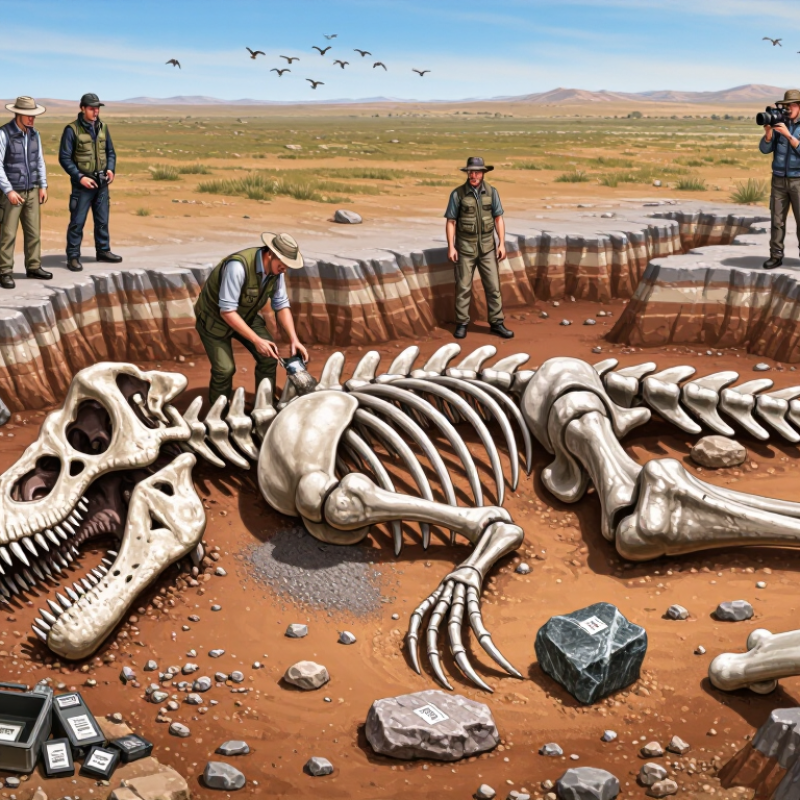
Excavation Excavation is slower than discovery. A brush, awl, and small pick remove sediment around the specimen. Teams photograph each layer before lifting anything. They record orientation, depth, rock type, and nearby plant or shell fossils. Fragile bones receive a protective plaster jacket, then travel with field notes and a specimen number. Soil samples may reveal pollen, ash, or microscopic grains that refine the age. Small details matter.

Provenance must remain visible from outcrop to collection. The Society of Vertebrate Paleontology’s 2023 ethics guidance emphasizes permits, documentation, and scientific access. Local land rules also control collection and export. Our first map point can be wrong. Experienced crews still miss crushed fragments or misread a weathered root. That uncertainty deserves honest records, not confident guesses. A productive site may look like a dusty slope, with one pale edge appearing after hours of careful scraping.

How Fossils Are Studied, Dated, and Preserved

Dinosaur fossils are mineralized remains or traces preserved in ancient sediments. Bones often become porous before groundwater carries minerals into their microscopic spaces. This process is called permineralization. Footprints, nests, skin impressions, and coprolites can also survive. Each record reveals different behavior, but none tells the whole story.

Field teams map the layer before removing a specimen. They record its position, rock type, orientation, and nearby fossils. That context matters. A bone without its geological setting loses part of its scientific value. The 2024 International Chronostratigraphic Chart places the Cretaceous Period between 145.0 and 66.0 million years ago. Researchers compare a fossil’s layer with volcanic ash beds when possible. Zircon uranium-lead dating can measure those ash layers with high precision. Potassium-argon and argon-argon methods may support additional age estimates. A date is not a birthday. It is a measured range with uncertainty.

Preservation begins with careful handling. Conservators stabilize fragile surfaces before cleaning loose sediment. They avoid aggressive tools that could erase tiny growth lines or bite marks. Stable temperature, low humidity changes, and limited light reduce future damage. Professional collections guidance emphasizes permanent records, unique specimen numbers, and reversible treatments. Yet preservation is imperfect. Some chemicals alter color. Some repairs hide original fractures. Digital scans help researchers study delicate fossils without repeated handling, but scans cannot replace the rock’s full context. Good practice keeps doubts visible.

What Are Dinosaur Fossils and How Are They Sourced?

Approximate duration of the three Mesozoic periods in which dinosaurs lived

Dinosaur fossils are preserved remains or traces of dinosaurs found mainly in sedimentary rocks. Scientists source them through geological field surveys and controlled excavation, then study their anatomy, rock layer, and surrounding minerals. Numerical ages are commonly estimated by radiometric dating of nearby volcanic ash layers, while relative ages come from stratigraphy. The Mesozoic durations shown here are approximate: Triassic, 50.5 million years; Jurassic, 56.4 million years; and Cretaceous, 79.0 million years. After excavation, fossils are stabilized, recorded, and stored in controlled museum or research collections.

Geological boundaries are based on the International Commission on Stratigraphy timescale; values are rounded.