China Best Anti Collision Cylinder Cap Manufacturer?
Choosing the China Best Anti Collision Cylinder Cap Manufacturer requires more than comparing prices or product photos. A dependable supplier must understand cylinder geometry, impact risks, thread accuracy, material performance, and long-term field handling. The right Anti‑Collision Cylinder Cap should fit securely, resist cracking, and protect the valve during transport, storage, and routine movement.
Cylinder-safety engineer Dr. Helen L. Chan offers a useful reminder: “A protective cap is a barrier, not a substitute for careful handling.” That principle deserves attention. Even a strong cap can fail when dimensions are poorly matched or installation is rushed. Small details matter. Wall thickness, polymer quality, molding consistency, and ventilation design can change practical performance.
This guide examines how Chinese manufacturers approach these requirements. It considers factory experience, inspection procedures, customization capability, packaging, and communication reliability. It also looks beyond polished catalogs. A supplier may show impressive samples, yet provide weak batch control or unclear testing records. That is where buyers must remain cautious.
Some conclusions may be uncomfortable. The lowest quotation is not always economical. A thicker cap is not automatically safer. Certification language can also confuse rather than reassure. Buyers should request measurable specifications, sample approval, production photographs, and traceable quality records.
The best manufacturer is not simply the one with the largest factory. It is the supplier that can repeatedly deliver a stable Anti‑Collision Cylinder Cap, explain its limitations honestly, and improve when testing reveals weaknesses. That standard creates a more practical path toward safe, consistent cylinder protection.
What Is an Anti-Collision Cylinder Cap?
China Best Anti-Collision Cylinder Cap Manufacturer?
What Is an Anti-Collision Cylinder Cap?
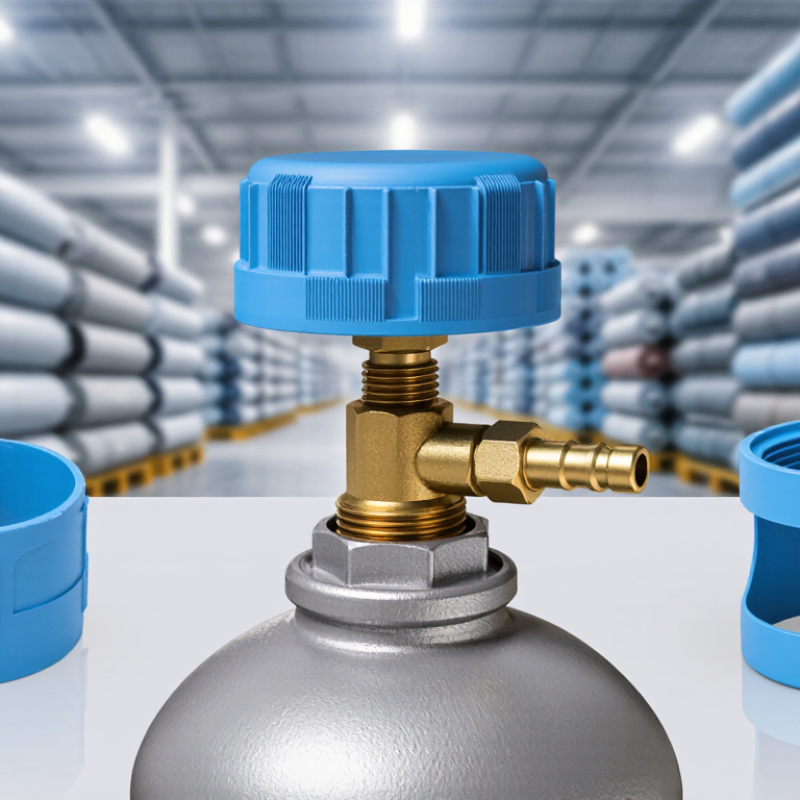
An anti-collision cylinder cap is a protective cover fitted over a gas cylinder valve. It helps reduce damage during lifting, storage, and transport. The cap absorbs contact from carts, racks, or nearby cylinders. It also prevents accidental knocks against valve components.
A reliable cap usually has strong threads, a stable shoulder, and enough internal clearance. Some designs include side openings for ventilation and easier handling. Steel offers high impact resistance, while engineered polymers can reduce weight and resist surface corrosion. The correct choice depends on cylinder size, valve shape, working conditions, and handling frequency.
Small details matter. A loose cap can move during transport. A poorly aligned thread may damage the valve connection. Experienced manufacturers check thread accuracy, wall thickness, impact strength, and surface finish during production. They should also test samples under repeated loading, not only inspect appearance. One detail is easy to miss: a cap may look strong but fail after cold-weather exposure. That weakness deserves honest review. A cap does not make a cylinder safe by itself. Proper filling, storage, inspection, and trained handling remain essential.
An anti-collision cylinder cap helps shield the valve and regulator connection from mechanical impact. The chart shows the calculated kinetic energy of a 50 kg cylinder assembly moving at different speeds, based on the physical formula E = ½mv². Because impact energy increases with the square of speed, secure handling, protective caps, and proper storage are essential.
How to Evaluate a Chinese Cylinder Cap Manufacturer
China Best Anti Collision Cylinder Cap Manufacturer?
When evaluating a Chinese cylinder cap manufacturer, begin with engineering evidence, not factory photographs. Ask for drawings, material certificates, valve compatibility records, and traceable batch numbers. The cap should be assessed against ISO 11117, which covers valve protection caps and guards for transportable gas cylinders. Request documented impact, drop, thread, and corrosion tests. Generic test videos are not enough.
The ISO Survey 2022 reported 1,265,216 ISO 9001 certificates worldwide. This indicates broad quality-system adoption, but certification alone cannot prove anti-collision performance. Review inspection plans, calibration records, nonconformance reports, and production samples. Check whether the supplier controls resin or metal variation, molding pressure, surface defects, and dimensional tolerances. A clean audit can still miss weak packaging or inconsistent subcontracting. That risk deserves attention.
Tips: Compare three samples from different batches. Measure thread engagement and wall thickness independently. Ask for a live production inspection. Confirm replacement procedures and response times. A supplier that answers precisely is more convincing than one offering polished promises. I would also keep a small pilot order. It costs more initially, yet it may reveal cracking, poor fit, or fading before full-scale purchasing. No checklist is perfect. Human judgment still matters.
Applications, Standards, and Quality Inspection Methods
China Best Anti-Collision Cylinder Cap Manufacturer?
Anti-collision cylinder caps protect valves during storage, transport, and loading. They are common in medical gas, industrial gas, and welding-cylinder applications. A reliable cap should resist side impacts, crushing, and repeated handling. ISO 11117:2019 provides requirements for valve protection devices on gas cylinders. Its scope covers design, testing, and performance verification.
Inspection should begin with material certificates and traceability records. Inspectors can check polymer or metal composition, wall thickness, thread accuracy, and ventilation openings. Every batch needs dimensional sampling. Record impact-test results, deformation, cracks, and thread damage. A cap that looks strong may still fail after repeated impacts. That is the uncomfortable part.
The U.S. PHMSA incident database shows that packaging damage remains a recurring factor in hazardous-material transport events. It supports stricter handling controls, although the database does not isolate cap failures. Testing should follow applicable ISO, EN, CGA, or national transport requirements. Check assembly torque with calibrated tools. Verify fit on the actual cylinder neck, not only on a laboratory gauge. Quality teams should retain photos, test curves, batch numbers, and nonconformance records. One missed dimension can create a costly field problem. Supplier audits should include production-line checks, not just final inspection.