
×

China Best Entrance Front Door Manufacturers for Buyers

China’s entrance-door market spans custom workshops and large-scale manufacturers. Buyers can compare timber, steel, aluminum, and composite options, but material alone tells only part of the story. An Entrance Front Door must fit the opening, local climate, daily use, and the building’s design. Small details matter: the threshold height, hinge feel, frame seal, and finish around the handle.

A useful sourcing principle comes from entrance-systems specialist Alex Morgan: “Judge a front door by its installation details, not its showroom shine.” For this guide, that line is a reminder to request more than attractive product photos. Ask manufacturers for clear dimensions, material specifications, finish options, warranty terms, and evidence supporting stated performance claims. Check how they handle samples, packaging, delivery schedules, and installation questions. These practical points can reveal gaps before an order is placed.

Look closely. Ask specific questions. A polished catalog is not proof of consistent quality. Buyers should compare suppliers using the same checklist and confirm that quoted specifications appear in the final documentation. Factory visits or sample reviews may help, though neither guarantees a flawless shipment. Some details remain difficult to judge from afar; that deserves honest attention. This overview will examine leading China-based manufacturers, their product strengths, customization capabilities, and the checks buyers can use to make a more informed choice.
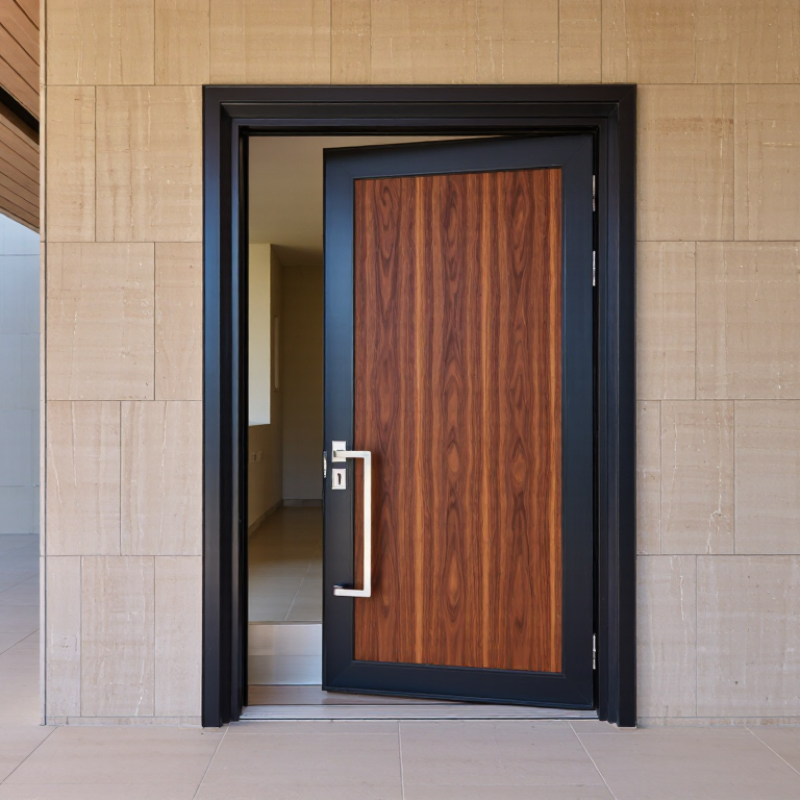
China Best Entrance Front Door Manufacturers for Buyers

Define China’s Entrance-Door Types and Their Main Buyer Applications

China’s entrance doors serve different buildings and buyers. Steel security doors are common for apartment units, where buyers prioritize a reinforced frame, reliable locking, and a finish suited to shared corridors. For detached homes and villas, aluminum-alloy or solid-wood doors offer more design flexibility; exposed entrances also need suitable weather seals and durable finishes. That distinction matters.

China’s National Bureau of Statistics reported 953.76 million square meters of newly started real-estate construction in 2023, down 20.4% year on year. This measures construction activity, not door sales, but it gives buyers useful market context: project specifications and replacement work may matter as much as new-build demand. Renovation buyers should measure the existing opening, frame depth, and wall condition before comparing quotations. A visually attractive door can still require costly adjustments. For apartment projects, confirm the required performance and documentation with the project team; requirements vary by building and location. For coastal or rainy sites, ask about corrosion resistance, drainage details, and seal maintenance. Small details count.

Compare Security Claims with GB 17565-2007 and EN 1627’s 6 RC Classes

When comparing entrance doors, do not treat GB 17565-2007 grades and EN 1627 RC classes as direct equivalents. They use different test frameworks and rating labels. EN 1627 defines six resistance classes, from RC1 to RC6, with higher classes generally requiring resistance to more demanding attacks. GB 17565-2007 sets performance requirements for Chinese security doors, including resistance to destructive opening. Labels are not interchangeable.

Check what the test actually covered. Ask for a report identifying the standard edition, door dimensions, lock configuration, frame, hinges, and installation method. A strong leaf can still be a weak door if its frame twists or its anchors pull out. Look for supporting tests, not just a grade printed on a brochure. Test the whole assembly.

A comparison table can make this look simpler than it is. It rarely is. EN RC classes include specified tools and attack methods; a claim under GB 17565-2007 follows its own procedures. Request the full report and confirm that the supplied model matches the tested sample. Small changes matter, especially around the lock case and frame fixing points. A rating without traceable evidence is only a claim.

How to read this comparison: EN 1627 RC2–RC6 correspond to 3, 5, 10, 15 and 20 minutes of manual attack resistance time, respectively. GB 17565-2007 uses a separate grading and test method: its minimum anti-destructive opening times are Grade A 30 minutes, B 15 minutes, C 10 minutes and D 6 minutes. These figures are not directly equivalent across standards; check the applicable test reports and certification for each door.

Check Fire-Door Options Against GB 12955-2008 Classes A, B, and C

When comparing entrance front-door manufacturers, verify the tested fire-door class against the building’s design requirements. Under GB 12955-2008, Class A, B, and C doors provide minimum fire-resistance periods of 1.5, 1.0, and 0.5 hours, respectively. These ratings are not interchangeable. Ask for test documentation that identifies the complete assembly, including the leaf, frame, seals, and hardware. A strong-looking door is not proof of a tested rating.

The risk is practical. NFPA’s Home Structure Fires report, covering 2017–2021, estimated an annual average of 358,500 home structure fires in the United States. That figure is not a China-specific forecast, but it shows why opening protection deserves careful review. Check whether the proposed class matches the project’s fire strategy, then confirm installation details and inspection arrangements. Small gaps matter. I would not choose by class label alone; the supporting test scope can be easy to overlook, and it deserves a second look.

Assess Manufacturer Quality Systems, Test Reports, Capacity, and Export Records

When comparing entrance front door manufacturers, inspect the quality system behind each sample. ISO’s 2022 Survey reported 1,265,216 valid ISO 9001 certificates worldwide, but certification alone does not prove a door’s performance. Ask for the certificate’s scope, site, and expiry date, then check whether production records trace a finished door to its frame, hardware, and inspection results. Paper is not proof.

Test reports should match the offered configuration, not merely a similar-looking product. Check the tested dimensions, glazing, locks, seals, and installation method. Reports based on standards such as ASTM E330 for structural performance or ASTM E283 for air leakage can clarify what was tested. Confirm the laboratory, report date, specimen details, and pass criteria. A polished report may still leave gaps. Ask what changed after testing.

Capacity and export records need the same scrutiny. Request recent production schedules, line capacity, lead times, and examples of corrective-action records; compare stated output with actual staffing and equipment. For export history, review redacted shipping documents, destination markets, and repeat-order references. UN Comtrade provides national trade flows, not individual factory verification, so treat it as context rather than proof. The World Bank’s 2023 Logistics Performance Index assessed 139 economies on areas including customs and timeliness; a manufacturer’s delivery record should still be checked directly. Small discrepancies deserve questions.

Compare Quotes by Specifications, Lead Time, Warranty, and Delivered Cost

For Chinese entrance front-door quotes, compare identical specifications, not just catalog photos. List the opening size, frame material, core, finish, glazing, hardware, threshold, and required test standard. Ask for performance data covering the exact door assembly. The U.S. Department of Energy notes that windows account for about 25%–30% of residential heating and cooling energy use; that figure is not specific to doors, but it shows why envelope performance deserves attention. ENERGY STAR reports that certified exterior doors are at least 15% more energy-efficient than standard products. Small differences matter.

Request separate timelines for production, inspection, packing, and transport, with a stated start date and shipment window. Confirm how the supplier handles delays or damage. A factory estimate is not a delivery promise. I would also check whether the sample’s finish and hardware match the production order; this detail is easy to overlook.

Compare warranty length, covered components, exclusions, and claim procedures in writing. Then calculate delivered cost using the same shipping terms for every quote. Include freight, insurance, port charges, customs-related fees, and inland delivery. The World Bank’s 2023 Logistics Performance Index evaluates shipment timeliness and logistics reliability across countries, so transit assumptions deserve scrutiny. A low unit price can lose its appeal when extra charges appear. I would still leave room for contingency: estimates rarely capture every delay or handling fee.