What Are the Best Acoustic Panels in 2026?
The best Acoustic Panels in 2026 are not necessarily the thickest, most expensive, or most attractive. They are the panels that solve a specific room problem without creating another one. A home studio may need control over early reflections, while a living room might benefit more from softer echoes and a finish that suits its décor. The right choice depends on room size, wall placement, panel thickness, and the sounds you want to manage. Small details matter. A handclap that rings near a bare wall tells you something; a panel’s product photo tells you much less.
Audio researcher Floyd Toole’s published work supports a practical idea: “The room is part of the sound system.” This is a paraphrase, not a verbatim quotation. It points to why panel claims deserve careful scrutiny. Acoustic treatment can reduce reflections and reverberation, but it cannot fix every sound problem, and panels are not the same as soundproofing. That distinction is easy to miss.
This guide compares options by absorption, construction, installation, appearance, and value. It also considers where each panel works best, from a compact podcast corner to a busy conference room. We’ll look at material descriptions and independent evidence where available, rather than treating bold marketing claims as proof. Some rooms still need measurement—or a different layout. That may be less satisfying than buying a quick fix, but it is often the more useful answer.
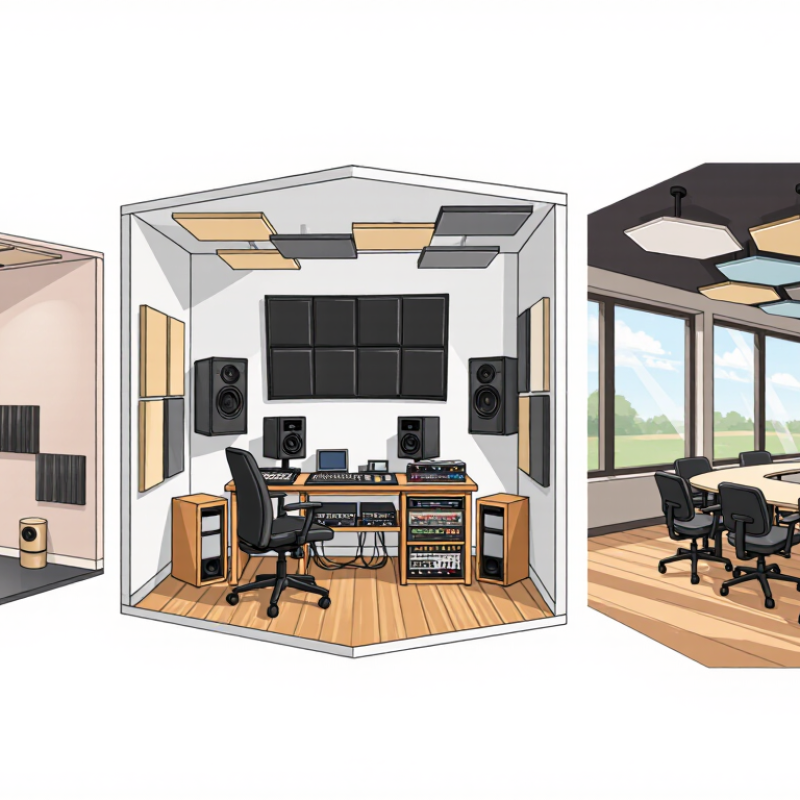
How Acoustic Panels Work: NRC Ratings Typically Range from 0 to 1
NRC, or Noise Reduction Coefficient, estimates how much sound a material absorbs rather than reflects. Its scale typically runs from 0 to 1. A value near 0 indicates little absorption; a value near 1 indicates strong absorption under the test conditions. The rating is generally rounded, so it is a useful comparison, not a precise promise for every room.
A panel rated 0.8 may help reduce echoes in a home office, especially when placed at reflection points near a desk or opposite a hard wall. But NRC does not tell you how well a panel blocks sound from a neighbor or a street. That is a different performance question. Nor does one rating describe absorption equally at every pitch; bass notes can behave quite differently from speech.
Numbers help, but real rooms are less tidy. A small, furnished room may sound clear with fewer panels than a bare room with tile floors and tall windows. Listen for lingering echoes, then consider panel thickness, coverage, and placement alongside the NRC figure. I’d be cautious about choosing solely by the highest number. A rating can look exact; the room rarely is.
Compare Panel Materials Using ASTM C423 Absorption Test Results
ASTM C423-23 measures sound absorption in a reverberation room, producing frequency-by-frequency coefficients and an overall Noise Reduction Coefficient (NRC). NRC averages results at 250, 500, 1,000, and 2,000 Hz, then rounds to the nearest 0.05. That detail matters: two panels with the same NRC can perform differently on low voices or sharp, high-frequency sounds.
For comparison, read the full test table, not just the headline number. Thick glass-fiber and mineral-fiber panels often absorb more broadly than thin, dense finishes, especially when mounted with an air gap. Recycled-fiber panels can also perform well, but density, thickness, backing, and mounting change the result. A 2023 ASHRAE Handbook chapter on noise control likewise treats absorption as frequency-dependent, rather than a single material trait. Small differences in installation can matter.
Look for the ASTM C423 test date, sample thickness, mounting type, and room setup in each report. Compare like with like. A 50 mm panel tested with an air space is not a fair match for a thinner panel fixed directly to a wall. I still find NRC easy to overread. For a meeting room, check mid-frequency values; for bass problems, inspect the low-frequency data and consider thicker treatment.
Match Panel Types to Room Reverberation Targets Under ISO 3382
What Are the Best Acoustic Panels in 2026?
The best panel depends on the room’s reverberation target, not its appearance alone. ISO 3382 provides methods for measuring reverberation time; it does not prescribe one ideal value for every space. A speech-focused meeting room usually benefits from a shorter decay than a music practice room. Small details matter.
Start with a baseline measurement. Use consistent speaker and microphone positions, and record the room’s use and furnishings. Broadband porous panels, such as fabric-wrapped mineral-fiber or foam absorbers, can reduce mid- and high-frequency reflections. Place them at reflection points on walls and ceilings. If low notes still linger, thicker absorbers or tuned resonant panels may help; thin panels often do little for bass.
Compare the measured decay with the room’s intended use, then add treatment gradually and measure again. A dramatic drop is not always an improvement: an over-damped room can feel flat, while untreated corners may keep bass uneven. Diffusers scatter reflections rather than absorbing them, so they are not a direct substitute when the reverberation target is missed. Results vary with room size, panel depth, and placement. That is easy to overlook. Keep a simple measurement log, and treat the target as a guide rather than a universal rule.
Verify Fire Ratings: ASTM E84 Class A Limits Flame Spread to 0–25
What Are the Best Acoustic Panels in 2026?
A panel’s sound absorption matters, but fire documentation deserves equal attention. ASTM E84 measures how building materials’ surfaces respond to flame and heat in a controlled tunnel test. Class A corresponds to a flame-spread index of 0–25. That rating is useful, but it does not mean a panel is fireproof.
Check the test report, not just a product-page badge. Confirm the exact panel construction was tested, including its facing and backing. Installation can matter too: adhesive, mounting gaps, and the surface behind a panel may affect whether the documented result applies. Look for the smoke-developed index as well; Class A commonly allows an index up to 450. A tidy label can be reassuring, but specification sheets are easy to misread. When details are unclear, ask the supplier or project professional for the full report.
Tips: Match the report to the panel you plan to install. Keep the documentation with your project records, and follow the stated mounting instructions. Don’t assume that a rating for one thickness or finish covers every version. That small distinction is easy to overlook.
Select 2026 Panels by Coverage, Mounting, Cost, and Tested Performance
Choosing the best acoustic panels in 2026 means matching coverage to the room, not chasing the highest rating. Measure the wall area, then note where sound reflects between hard surfaces. A few panels may calm a sharp echo, but sparse coverage can leave speech muddy. Coverage matters. For a living room, start near the first reflection points; for a meeting room, consider the walls behind speakers and listeners.
Check mounting before comparing prices. Adhesive suits lightweight panels on clean, stable surfaces, while mechanical fixings offer a more secure option for heavier units. Compare installed cost per treated square foot, including hardware and any professional labor. Leave access to outlets, doors, and sprinklers. Small detail, big headache. I would still avoid treating every wall: too much absorption can make a room feel unnaturally dull.
Ask for laboratory results, not just claims like “soundproof.” ASTM C423 measures sound absorption in a reverberation room; its NRC figure averages results at 250, 500, 1,000, and 2,000 Hz. NRC is useful, but it does not show performance at every frequency or predict your exact room. For context, ANSI/ASA S12.60 sets a 0.6-second reverberation-time limit for smaller core learning spaces. That classroom benchmark is not a universal home target. Compare test reports, panel thickness, mounting method, and stated frequency data before buying.